

There's a question making the rounds at every industry event, forum and peer group right now:
How are you using AI at your company?
It's a great question to start the conversation, but it's too broad to be useful. Consider the equivalent question applied to human intelligence: "How are you using people at your company?" You'd struggle to answer without getting more specific. A project manager, a designer and a sales leader all represent human intelligence; but grouping them together obscures more than it reveals.
AI is no different. It spans a vast range of capabilities, and a single label flattens them into noise. What we need is a shared, richer vocabulary.
We see four meaningfully distinct tiers of AI operating in the world today.
Four tiers of AI
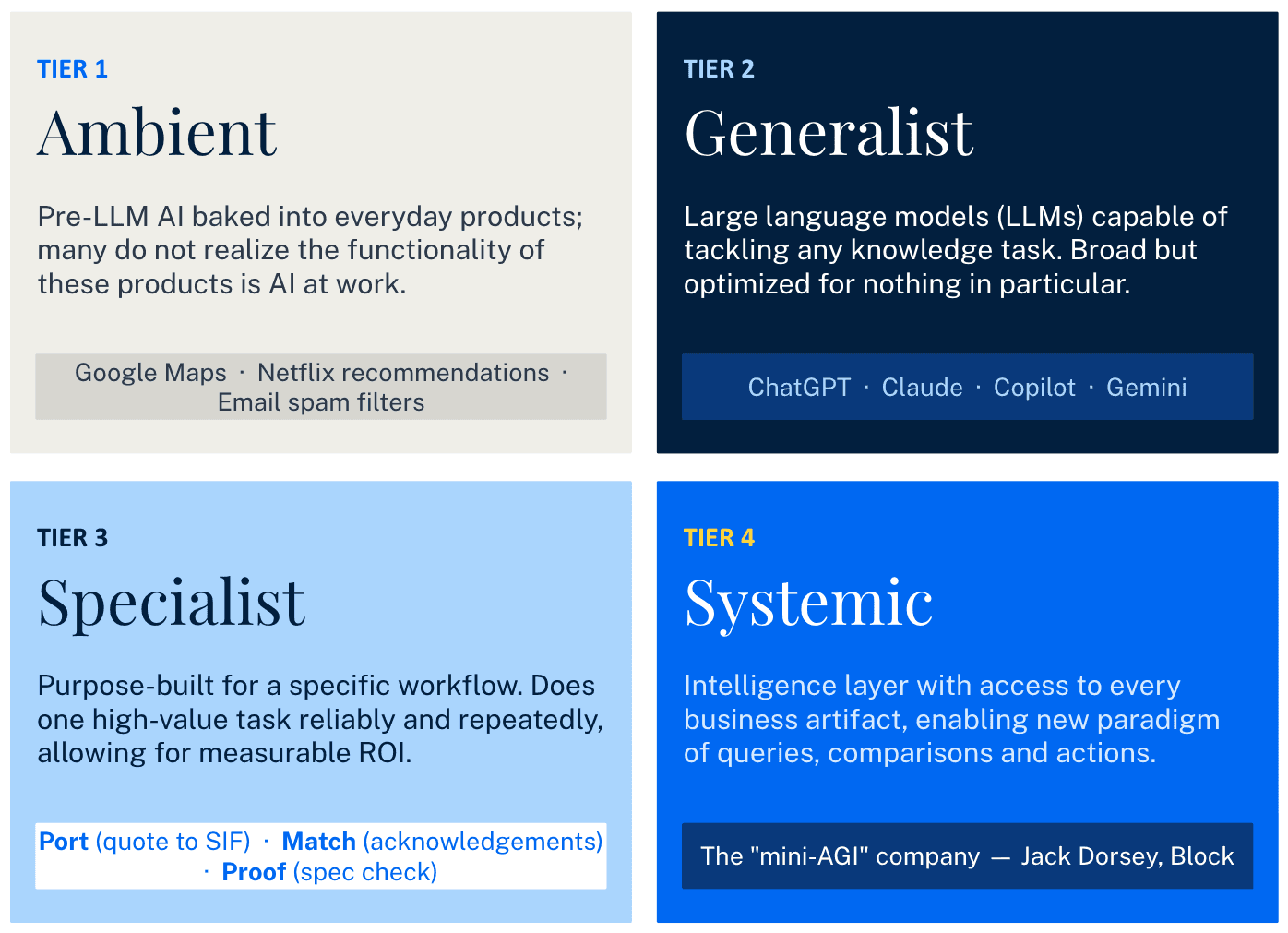
1. Ambient
Ambient AI has been part of daily life for decades, long before ChatGPT made AI a household topic. It operates invisibly in the background, predicting and optimizing.
Google Maps decides your driving route; Netflix decides what to surface in "watch next". Your spam filter silently protects you from unwanted email.
This is artificial narrow intelligence (ANI), and it's unremarkable precisely because it just works. Most people don't think of it as AI at all.
2. Generalist
Generalist AI refers to large language models (LLMs); systems trained on vast amounts of human knowledge that can turn their hand to almost any knowledge task: drafting an email, summarizing a spec sheet, answering RFP questions, or turning random fridge contents into a cohesive meal.
The most common entry points are ChatGPT and Claude as standalone products, or Copilot and Gemini for companies running Microsoft and Google environments respectively.
Generalist AI is genuinely useful. It's also intentionally broad, which is both its strength and its limitation: it can help with almost anything, but is optimized for nothing in particular. ROI is hard to measure; as a general productivity tool, the benefit varies by user and skill level rather than being tied to a specific task.
3. Specialist
Specialist AI is purpose-built for a specific workflow or role. Where Generalist AI is a talented all-rounder, Specialist AI is a trained expert.
In contract furniture, this is where purpose-built tools operate. Port automates the transfer of product data into SIF; Match reconciles acknowledgments against purchase orders (POs). These tools don't try to do everything; they do one high-value, high-friction task reliably and repeatedly.
This is also where measurable ROI starts to appear. Organizations can reasonably estimate the human effort to complete these specific tasks as well as the baseline error rates, so time and accuracy savings are quantifiable.
4. Systemic
Systemic AI doesn't describe a tool or product you can buy today. It describes a more holistic integration of AI, one that a small number of forward-thinking companies are architecting toward.
The clearest articulation of this vision comes from Jack Dorsey, who argues that every company can now become a "mini-AGI" (Artificial General Intelligence). His thesis: every artifact a company produces, every meeting note, every proposal, every lookbook, every SIF, every budget, is a signal about how that company works, builds, and decides. No single human can absorb all of it, so today that information sits compartmentalized and moves slowly through a chain of command. In the future, an intelligence layer on top of all company artifacts enables dramatically faster decision making and production.
In contract furniture, that would mean proposals and projects could be generated almost instantly based on a customer's revealed needs, because the dealership itself becomes an intelligence. Any need that cannot be fulfilled becomes the dealership’s true job and investment roadmap.
While this is emergent, and nobody has built it yet, it is a reasonable projection of the future.
Where Most Companies Are Today
Most are at Tier 2 Generalist, with early adopters exploring Tier 3 Specialist.
Generalist AI is accessible, bundled for all companies running Microsoft or Google, and easy to start with, enabling experimentation and learning. The challenge is that the ROI is unclear and skill levels vary widely.
Specialist AI is where the ROI becomes visible. It is also the necessary precursor to Tier 4 Systemic, because an intelligence layer cannot be built on top of messy, manual, undocumented processes. The companies investing in Specialist AI now are not just solving today's operational problems; they're laying the foundation for a fundamentally different kind of company.
So: Stop asking “How are you using AI at your company?”
Start asking: “Which tier of AI is your company operating at, and what would it take to reach the next one?”
Get started
Focus Your People On Work That Matters
Book a Demo